Wednesday, October 28, 2015

MODES OF HEAT TRANSFER

Heat is a form of energy which transfers between bodies which are under thermal interactions. Heat transfer occurs when a temperature difference occurs between two bodies or a body with its surroundings. 
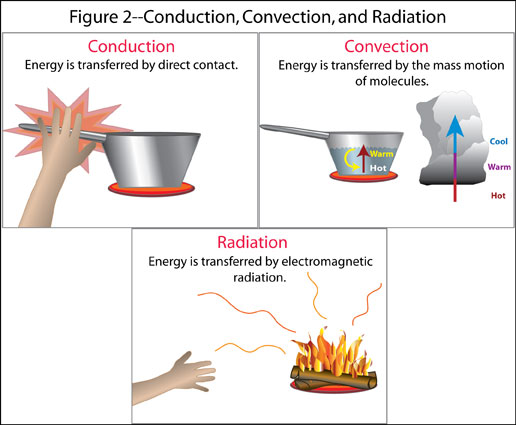
There are three modes of heat transfer:
  1. Conduction
  2. Convection and
  3. Radiation
CONDUCTION: Conduction is the mode of heat transfer which occurs from one part of a substance to another part within the substance itself or with another substance which is placed in physical contact. 
CONVECTION: Heat transfer occurs within a fluid itself and it is carried out by transfer of one fraction of the fluid to the remaining portion. 
RADIATION: This mode of heat transfer does not require any medium to occur. Every matter with a temperature above absolute zero will emit energy in the form of electromagnetic waves called radiation.

QUANTITY OF HEAT

The quantity of heat energy (Q) gained or lost by a substance is equal to the mass of the substance (m) multiplied by its specific heat capacity (C) multiplied by the change in temperature (final temperature - initial temperature)

Q = m x C x (Tf - Ti)

Memorize this formula well.

  • Specific Heat Capacity (C) of a substance is the amount of heat required to raise the temperature of 1 gram of the substance by 1C (or by 1 K).
  • Heat capacity (H) is defined as the mass multiplied by the specific heat capacity.        H = m x C
  • The quantity of heat can therefore be defined as heat capacity multiplied by the change in temperature. Q = H x C
Example:
Calculate the quantity of heat needed to raise the temperature of 250 grams of water from 20C to 56C. (Heat capacity of water is Cg = 4.18 J oC-1 g-1)

Solution: Q = m x C x (Tf - Ti) 
m = 250 g; Tf = 56oC; Ti = 20oC

q = 250 x 4.18 x (56 - 20) 
q = 250 x 4.18 x 36 
q = 37620 J = 38 kJ

GERMINATION OF SEEDS

1. The seed contains the embryo of the new plant.
2. It has a supply of food for the embryo until it has formed sufficient roots and leaves to obtain its own food. 
3. The food, referred to as the endospermmay be in the seed leaves (called the cotyledons) or it may be outside the seed leaves.
4. To germinate, the seed leaves absorb water and swell, and the seed roots (called radicle) emerges, followed by the seed shoot (called plumule).


THE FLOWER

The flower has a male and female parts. These may be on the same flower or on different ones. Below are the various parts of a typical flower.


1. The male part of the flower is called the stamen and it consists of the anthers and filaments. The anthers contains the pollen grains.
2. The female part of the flower is called the pistil. It consists of the stigma, the style, ovary and ovule.
3. The stigma is sticky and it attracts the pollen during pollination.
4. Pollination is the transfer of pollen from the anthers to the stigma. It may be self or cross-pollination. Self-pollination involves the same flower whereas, cross-pollination involves different flowers.
5. The pollen grows through the style into the ovary to fertilize the ovule.
6. Fertilization leads to seed production and embryo formation. So the seed is the fertilized ovule.
7. The petals are colorful and they attract the agents of pollination such as bees, butterflies, etc.
8. The ovary wall becomes the fleshy part of the fruit.

This diagram summarizes the functions of the various parts.

METABOLISM

Metabolism is the building up (synthesis) or the breakdown of substances in the living organism. It consists of anabolism and catabolism.

Anabolism is the formation or synthesis of complex substances from simple ones. That is, A + B -----> C.
An example of anabolic reaction is photosynthesis.

Catabolism is the breakdown of complex substances into simple ones. That is, C -----> A + B.
An example of catabolic reaction is respiration.

What is photosynthesis?
This is the process whereby  plants produce their food (glucose) using carbon dioxide, water, and energy from the sun,  in the presence of chlorophyll (the green pigment in the leaves). Chlorophyll is contained in the chloroplast and it traps the energy from the sunlight. Glucose is the main product formed and oxygen is given off as waste.

This the equation that summarizes photosynthesis: 6CO+ 6H2à C6H12O+ 6O2
This is carbon dioxide: CO
This is water: H2O
This is glucose: C6H12O6
This is oxygen: O2

Note: You should know this equation off-hand. 

Water goes up from the roots through the plant vessel called xylem.
The glucose formed in the leaves are transported to storage sites via the plant vessel called phloem.

The glucose is stored as starch in the plants.

Respiration
Respiration involves the breakdown of glucose in the presence of oxygen to release energy in the form of ATP (ATP stands for adenosine  triphosphate, the energy currency). ATP is generated in the mitochondrium. Respiration is a combustion reaction since oxygen is needed.

There are three (3) stages in the process of respiration.
1. Glycolysis: Glucose is activated and broken down to pyruvate.
2. Kreb's cycle (also known as the Tricarboxylic Acid Cycle - TCA cycle): Some ATP, NADH, FADHare produce here.
3. Electron Transport Chain (ETC): Most ATP's are produced here.

This equation summarizes the reaction of respiration:
 C6H12O+ 6O à6CO+ 6H2

Know this very well. It is simply the reverse of photosynthesis reaction.

In the absence of oxygen, pyruvate is converted into lactic acid, which  causes muscle cramps. When oxygen is available, the lactic acid is changed back to pyruvate which is then used up in the Kreb's cycle.

Fermentation
This is the process whereby glucose is changed to alcohol in the absence of oxygen.

Thursday, October 22, 2015

TYPES OF NATURAL SELECTION?

In the previous blog, I explained what natural selection is about. Today, I will delve into the different ways in which it is classified.

SELECTION BASED EFFECT ON A TRAIT
1. Stabilizing selection: This acts in such a way that the trait is held at a stable optimum. For example, tall plants in a forest are susceptible to being blow down by the wind; short plants are susceptible to competition for sunlight; so that compromise leads to the development of medium height plants.

2. Directional selection: This acts during transitional periods when the current mode of the trait is sub-optimal, and alters the trait towards a single new optimum. For example, the shortage of food at ground level made it difficult for the giraffe with short necks to survive. The development of long necks

3. Disruptive selection: This acts during transitional periods when the current mode is sub-optimal, but alters the trait in more than one direction. Example: If there are three types of plants in an area, tall, medium, and short, that are pollinated by three individuals. If the pollinator of the medium plant is no more there, the medium plant's population will decrease while that of the short and tall will remain. 

SELECTION BASED ON EFFECT ON ALLELE FREQUENCY
1. Positive selection: This effect leads to an increase frequency of an allele.

2. Negative selection: This effect leads to a decrease in the frequency of an allele.

SELECTION BASED ON EFFECT ON GENETIC DIVERSITY
1. Purifying selection: This acts to remove the genetic variation in a population.

2. Balancing selection: This acts to maintain the genetic variation in a population.

Tuesday, October 13, 2015

EXERCISES AND ITS BENEFITS

Regular exercise helps improve the overall health. These benefits include:


  • Stronger muscles
  • Stronger bones
  • Stronger joints
  • Improved immune system with reduced risk of infectious diseases
  • Reduced risk of pre-mature death
  • Reduced risk of heart disease
  • Improved psychological well-being
  • Improved memory
  • Improved weight loss management and reduced risk of obesity
  • Lowering of cholesterol
  • Reduced risk of certain cancers
  • Lowering of blood pressure
  • Reduced risk of stress-related disorders

Thursday, October 8, 2015

SEXUAL REPRODUCTION IN ANIMALS

Gametes refers to the sperm and the egg. During sexual reproduction, the sperm and the egg unite to form the zygote.
                           Zygote = sperm + egg

Each gamete has half the normal complement of chromosomes, that is, 23 chromosomes in each gamete. The gametes are said to be monoploids (haploid). Fusion results in the full number of chromosomes, 46 (23 pairs). The zygote is referred to as diploid.

In the male, the external reproductive organs are the penis and scrotum.
The internal organs consist of:

  • The testis which contains the seminiferous tubules, where the sperms are produced.
  • The interstitial cells produce testoterone, the male sex hormones.
  • The sperm travels in the epididymis, the coiled tubules, into the vas deferens to the ejaculatory duct to the urethra.
  • Seminal vesicles produce seminal fluid that carries the sperms.
  • Prostate produces prostatic fluid that also carries the sperms.

In the female, the primary reproductive organs are the ovaries, fallopian tubes and uterus.

  • Ovaries produce the eggs and the hormones, estrogen and progesterone.
  • Immature egg is called oocyte.
  • Matured egg is released during ovulation.
  • The egg travels in the fallopian tubes, where it can be fertilized by the sperm. Note that the fertilized egg begins to divide within the tubes within few hours of conception.
  • The lining of the uterus is called the endometrium.
  • The fertilized egg implants in the endometrium.
  • The fetus obtains nourishment via the placenta. Note that, the fetal and maternal blood do not have direct connections. Exchange of nutrients and oxygen is by diffusion.
  • The fetus is connected to the placenta via the umbilical cord.
  • The fetus is covered by the following membranes: amnion and chorion.
  • If there is no fertilization, the uterus sheds its, endometrium. This is referred to as menstruation.