Tuesday, January 13, 2015

THE PROCESS OF MEIOSIS

Meiosis is a special type of cell division that occurs in the gonads or sex organs.
  • At the end of meiosis, the number of chromosomes is reduced by half. That is, meiosis of diploid cells produces haploid daughter cells.
  • These cells can then function as gametes that can undergo fertilization resulting in the restoration of the diploid number of chromosomes in the zygote.
  • Meiosis and fertilization introduce genetic variation in three ways:

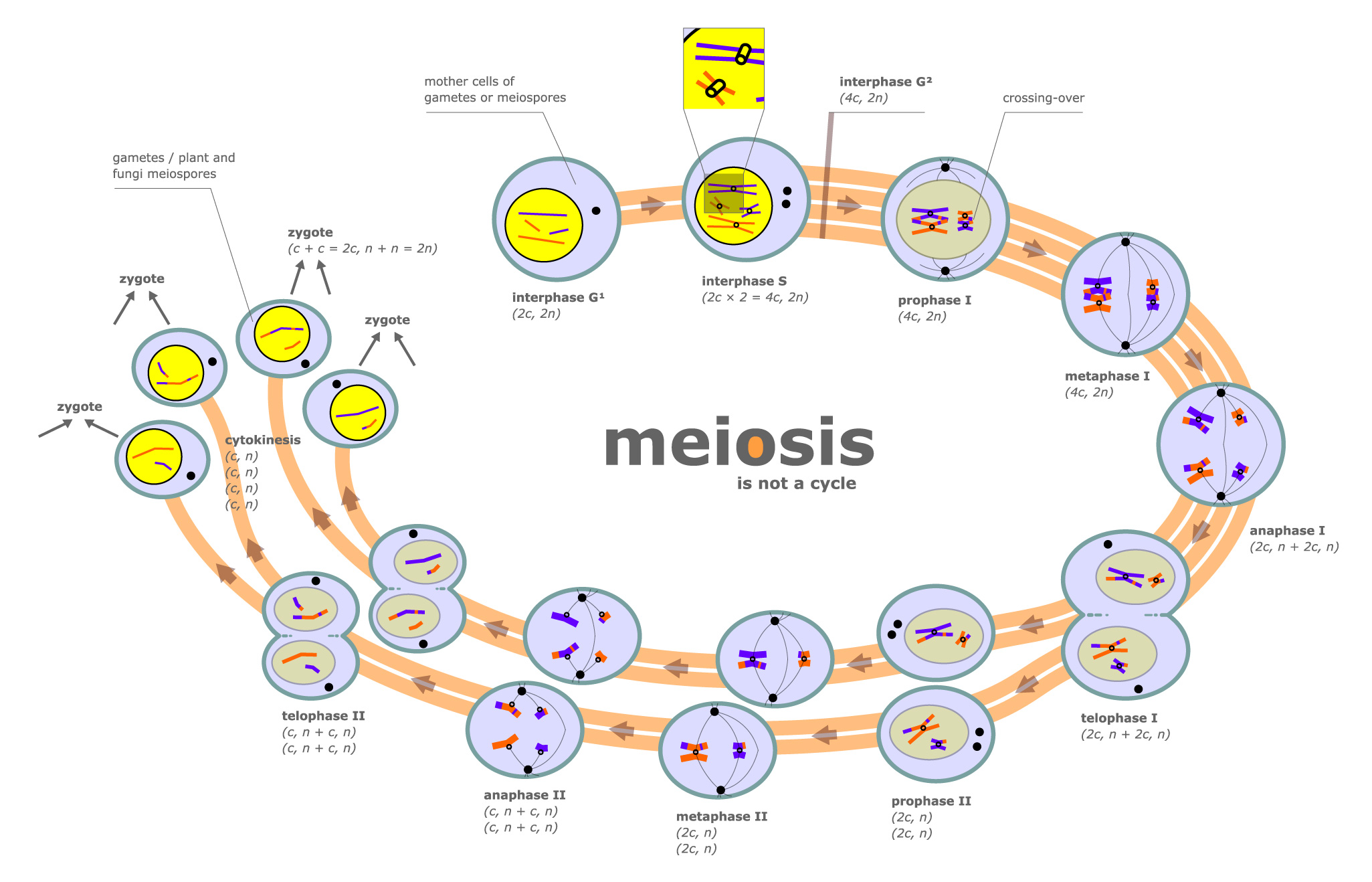
    The meiosis consist of two main stages:

    •  Meiosis I: This is made up of four sub-stages: Prophase I, Metaphase I, Anaphase I and Telophase I
    •  Meiosis II: This is made up of four sub-stages: Prophase II, Metaphase II, Anaphase II and Telophase II

      You can click on this link to view a diagram on the meitotic process. This will help you to visualize the steps described below.

      MEIOSIS I
      Prophase I 
      • The chromosomes condense and become visible.
      • The centrioles form and move toward the poles.
      • The nuclear membrane begins to dissolve.
      • The homologs pair up, forming a tetrad. 
      • Each tetrad is comprised of four chromotids - the two homologs, each with their sister chromatid.
      • Genetic material from the homologous chromosomes is randomly swapped. This process is known as crossing over. 
      • Crossing over increases genetic diversity by creating four unique chromatids.

      Metaphase I
      • Microtubules grow from the centrioles and attach to the centromeres
      • The tetrads line up along the cell equator.


      Anaphase I
      • The centromeres break and homologous chromosomes separate with the sister chromatids are still attached.
      • Cytokinesis begins.
      Telophase I
      • The chromosomes may decondense.
      • Cytokinesis reaches completion, creating two haploid daughter cells


      MEIOSIS II 
      Prophase II
      • Centrioles form and move toward the poles.
      • The nuclear membrane dissolves.
      Metaphase II
      • Microtubules grow from the centrioles and attach to the centromeres.
      • The sister chromatids line up along the cell equator.

      Anaphase II
      • The centromeres break and sister chromatids separate. 
      • Cytokinesis begins.
      Telophase II
      • The chromosomes may decondense.
      • Cytokinesis reaches completion, creating four haploid daughter cells.


      No comments:

      Post a Comment